

There is a small episode in the sīrah that we rarely dwell on, and yet it teaches us almost everything we need to know about how to live as Muslims in a hostile world.
Just before the Battle of Badr, the Messenger ﷺ sent a small group of companions on a reconnaissance mission — to track a Quraysh caravan making its way back towards Mecca. It was not a military expedition. They were sent only to observe. But when the Ṣaḥāba followed the caravan, they saw that it was a rich one, lightly guarded, and easily taken.
You have to understand what that caravan meant to them. Much of what those caravans carried had been stripped from the Muslims during the hijrah. When they migrated, their homes and possessions were seized by the Quraysh. So to the Muhājirīn, every passing caravan was a reminder of what had been stolen — and a chance to take it back.
But as they drew closer to Mecca, they fell into a dilemma. It was the last day of Rajab, one of the sacred months, in which — since the time of Ibrāhīm ʿalayhi s-salām — no violence was to be initiated. Wait one more day, and the caravan would slip into the sanctuary of Mecca, untouchable. Attack today, and violate the sanctity of Rajab. They chose to attack. Some of the Quraysh were killed, the caravan was seized, and it was brought back to Medina.
The Messenger ﷺ refused to accept it. This had been a reconnaissance mission, he said; they were not to kill; this was the sacred month. And the Quraysh, seizing their chance, made a spectacle of it: Look at these Muslims. They claim to inherit the way of Ibrāhīm, and here they are shedding blood in the sacred month.
So how did Allah teach us to read this event? The Muslims had done something wrong — but they were of us. Do we defend our own at all costs?
يَسْأَلُونَكَ عَنِ الشَّهْرِ الْحَرَامِ قِتَالٍ فِيهِ ۖ قُلْ قِتَالٌ فِيهِ كَبِيرٌ ۖ وَصَدٌّ عَن سَبِيلِ اللَّهِ وَكُفْرٌ بِهِ وَالْمَسْجِدِ الْحَرَامِ وَإِخْرَاجُ أَهْلِهِ مِنْهُ أَكْبَرُ عِندَ اللَّهِ ۚ وَالْفِتْنَةُ أَكْبَرُ مِنَ الْقَتْلِ
“They ask you about fighting in the sacred month. Say: fighting therein is a great sin — but barring people from the path of Allah, disbelief in Him, keeping people from the Sacred Mosque, and driving out its people, that is greater in the sight of Allah. And persecution is worse than killing.” (al-Baqarah 2:217)
Notice what Allah does here. He says two things at once, and He holds on to both.
First: “Qul qitālun fīhi kabīr” — say it plainly, it is a grave sin. The wrongdoing is named, and it is named even though the wrongdoers were Muslims. We call a spade a spade, no matter who holds it. When it is our own family, our own community, our own religion — it makes no difference. Justice comes before tribe. What is wrong is wrong.
But in the same breath, Allah refuses to let the Quraysh get away with their selective framing. Look at the Muslims, they kill in the sacred month — yes, but look at the fuller picture. Why did the Muslims retaliate as they did? History did not begin with that expedition. It began long before, with a people persecuted, tortured, robbed, and driven from their homes. What do you expect when you oppress a people for years?
Both truths, together. The wrong is a wrong. And the wrong did not fall out of a clear sky.
Twenty-five years
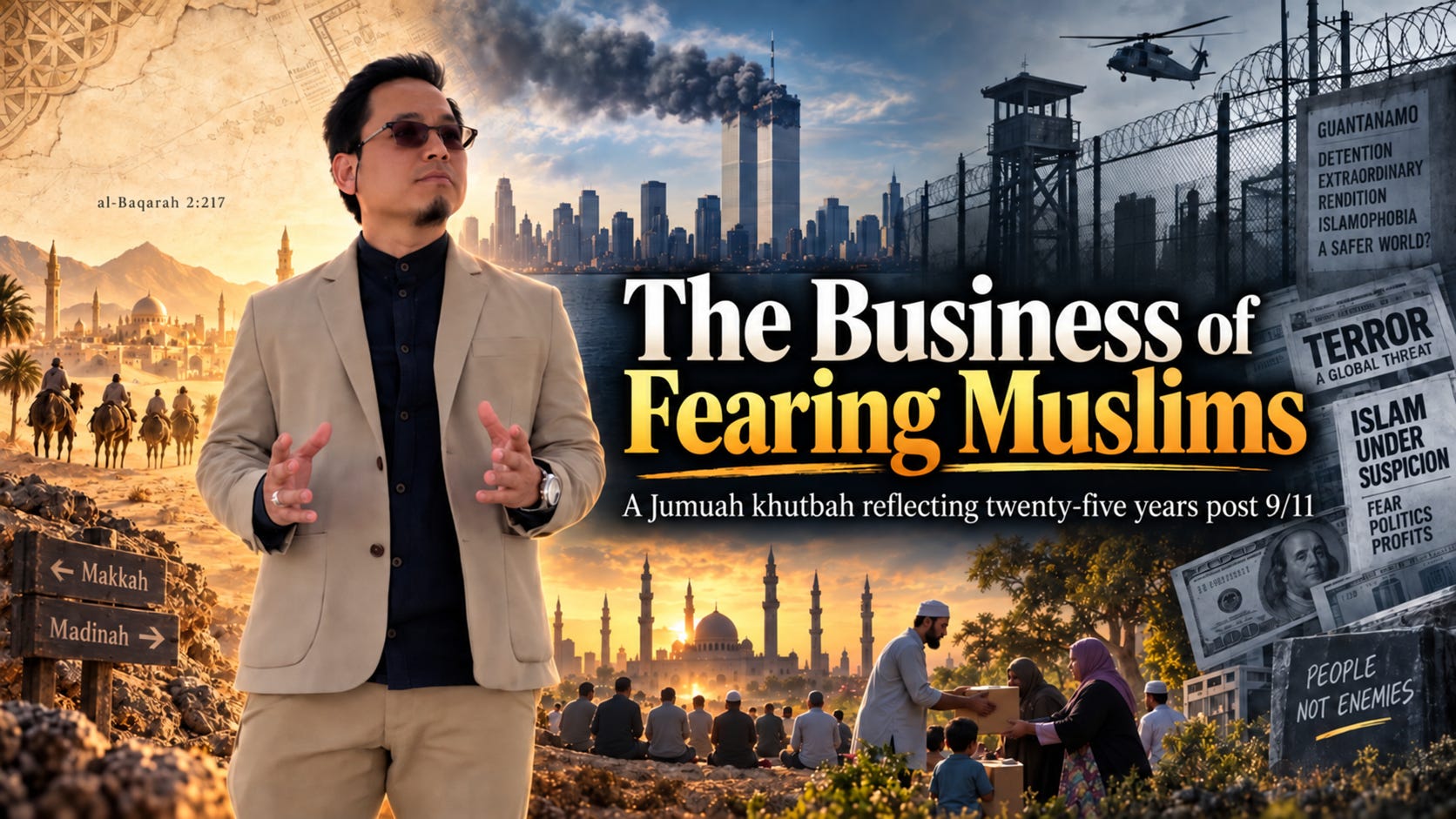
Today, twenty-five years ago, a group of Muslims attacked the World Trade Center, and they did it in the name of our religion. This āyah could not be more relevant to us.
Qul qitālun fīhi kabīr. Killing civilians, killing non-combatants, is ḥarām. When Muslims go to war, we are bound by the rules of engagement the Messenger ﷺ himself laid down: the innocent are not to be harmed. People going to work; strangers boarding a plane — that is mass murder. It is ḥarām, and we condemn it without hesitation and without qualification.
But we do not read the event in a vacuum. History did not begin twenty-five years ago. Al-Qāʿida did not appear from nowhere. Its founder, Osama bin Laden, was among the mujahideen the United States itself armed and funded through the CIA in Afghanistan, when Afghanistan was a proxy battlefield against the Soviets. When that war ended, the fighters remained — and a superpower that had defined itself against one enemy went looking for another.
Noam Chomsky, writing in the very year the Soviet Union dissolved, said America would need a new enemy, and the Muslim world was the convenient one. Instil fear of Muslims in the public, and the public will accept an almost limitless spend on war. And follow the money: Joseph Stiglitz, a Nobel laureate in economics, put the cost of the “War on Terror” at somewhere between four and six trillion dollars — of which a huge share went to a handful of private companies.
Three thousand people died on that September morning. In the wars that followed, in Afghanistan and Iraq and beyond, the dead numbered in the millions. This was not the doing of ordinary Americans, most of whom wanted no part of it. It was the doing of a small circle who understood one thing: fear is profitable.
Because that is what Islamophobia is. It is not just a prejudice sitting in people’s hearts. It is an industry — a multi-billion-dollar one. Billions are spent on it on purpose: on films, on news coverage, on think tanks and media campaigns built to keep the fear alive, because as long as the fear is alive, the spending continues and someone, somewhere, keeps getting paid. We are not imagining the hostility. It is manufactured, it is funded, and it turns a profit. And we still live inside that campaign today.
The anger is real. And it is justified.
The anger is real. And much of it is justified.
When we saw the photographs from Abu Ghraib — prisoners stripped, hooded, piled on top of one another, dragged on leashes, made to stand on boxes with wires at their fingertips; women among them abused, some raped — that anger was not irrational. It was what any human heart feels in front of something monstrous. When we learned of Guantánamo Bay — men held for years without charge, without trial, without a court to answer to; force-fed, tortured, some of them entirely innocent, released two decades later with an apology from no one — that anger was not a sickness in us. It was our conscience doing exactly what Allah made it to do.
Islam does not ask you to feel nothing in the face of injustice. The Prophet ﷺ taught that the one who sees a wrong and does not even hate it in his heart has reached the weakest edge of faith. To be unmoved by cruelty is not piety. So do not let anyone shame you for the anger. The anger is a sign that your heart is still alive.
But the anger is real — and what we do with it is everything.
The same anger that can build can also burn. Channelled rightly, it becomes patience, resolve, service, truth spoken to power, a community that will not be broken. Channelled wrongly, it becomes the very thing our enemies are praying we become — and when a handful act wrongly out of real grievance, it is not they alone who pay. It is the whole ummah. It is the woman in the hijab spat at on the train the next morning. It is the child at school who now carries a name that frightens people. It is the masjid firebombed, the visa refused, the checkpoint, the watchlist. One reckless act, born of real pain, hands our persecutors the exact story they have spent fortunes trying to write.
So the question is not should we be angry. The question is the harder one: what do we do with it?
There are three things we need to do — and we can, and should, begin with them now.
The first: establish the salah
The Islamophobia industry is not new. Using entertainment and influence to smear Muslims and turn people against them was done to the Prophet ﷺ and the earliest Muslims. Abu Jahl paid singers and poets — he funded the “Hollywood” of his day — to drown out the message of the Prophet ﷺ and to spread fear and contempt for the Muslims of Mecca. And later, in Medina, the Ahl al-Kitāb ran their own smear campaigns against the Muslims. The first generation knew exactly what it was to be lied about, laughed at, and hated by people who had never met them.
So what is Allah’s response to that? When the Qur’an speaks of the deep hatred some harboured towards the believers — “wadda kathīrun min ahli l-kitāb”, how many wished to turn you back from your religion, out of envy — look at what Allah tells us to do:
وَأَقِيمُوا الصَّلَاةَ وَآتُوا الزَّكَاةَ
“And establish the prayer, and give the zakat.” (al-Baqarah 2:110)
Two commands, and the first is wa aqīmu ṣ-ṣalāta — establish the prayer. Prayer centres us. It gives us purpose. When we pray, we are holding on to something far greater than us — greater than all of the worlds. We are doing it for the Lord of the Worlds. We are talking to our Creator.
That is where our strength comes from. Without Allah we are nothing, and nothing brings us closer to Him than the salah. A community rooted in that connection cannot be goaded into losing itself — because what matters most to it is not the headlines. It is the sujūd.
The second: give the zakat
Wa ātū z-zakāh — and give the zakat. If salah is how we hold our relationship with Allah, zakat is how we hold our relationship with everyone else. And this — not violence, and not even argument — is how the smear is actually defeated.
We cannot out-spend the Islamophobia industry. Billions go into it; we do not have billions to counter it. But if each and every one of us becomes a torchbearer of the prophetic akhlāq — so that at your workplace, when someone is in trouble, short of money, facing an emergency, the first thought in the room is: find the Muslim, he’ll help. So that on your street, the neighbours simply know: that household is always ready, always going out of its way. So that when your colleague reads something ugly about Muslims online, a quieter voice answers inside them: that can’t be the whole truth — the Muslim two doors down was the one who showed up when we had nothing.
There are seventy thousand Muslims in this city. If each of us leaves a real impression on just four or five people, there is scarcely a soul in Perth who has not had a good, first-hand encounter with a Muslim. And that one real experience will do what no argument can — it cancels out the billions spent to make us into monsters. We change one mind at a time. One house at a time. Door to door, we carry the prophetic torch, and no smear campaign, however well-funded, can outlast it.
The third: know the seerah
The third thing is that we must know the sīrah of our Prophet ﷺ — well enough that when a colleague or a neighbour repeats the old line that Islam is a religion spread by the sword, we can answer it.
There is a book worth knowing here, written by a non-Muslim: the American historian Juan Cole, Muhammad: Prophet of Peace Amid the Clash of Empires. His argument is that the Prophet ﷺ was not a prophet of war or of terror, but a prophet of peace, and that his whole life bends towards that end.
Look at the world he was sent into. Arabia was lawless, war and raiding everywhere, the wider world locked in the clash of two superpowers, the Romans and the Persians. He did not bring war into that world; he inherited it, and he spent his life trying to end it. Victorious at Badr, he pardoned prisoners. Defeated at Uhud, he forbade the mutilation of his enemies. Master of Mecca at the height of his power, he looked at the people who had tortured his companions and driven him from his home and said, “Idhhabū fa-antum ṭulaqāʾ” — go, you are free, there is no blame upon you today.
And look at what peace did for this dīn. At Badr there were 313 believers, and the growth was slow. By Ḥudaybiyyah, perhaps 1,400. But in the two years of peace that the treaty of Ḥudaybiyyah bought — a treaty so lopsided against the Muslims that the companions could barely accept it, and which the Prophet ﷺ signed anyway because he wanted the fighting to stop — Islam grew from 1,400 to 10,000. And in the years after the conquest of Mecca, it grew again, to 120,000. Islam grew best in peace, because our Prophet ﷺ was, as the Qur’an names him, wa mā arsalnāka illā raḥmatan li-l-ʿālamīn — and We did not send you except as a mercy to the worlds.
So today, twenty-five years on from an event that changed the world, we come back to where we always come back to.
Feel the anger; it means your heart is alive. But do not let those who profit from your rage decide what you do with it. Bring it to Allah in the prayer. Then take it out into the world as mercy — the generosity, the kindness, the compassion of the Prophet ﷺ, who knew, better than any of us, what to do with the anger.
Wa aqīmu ṣ-ṣalāta wa ātū z-zakāh.